Trends
14 August 2026


There’s something quietly uncompromising about Hans. Part engineer, part craftsman, part musician, his path into studio building wasn’t planned; it unfolded. What began with a single request from a former student turned into a decades-long career shaping recording spaces across the Netherlands and beyond.
We sat down with him to talk about instinct, imperfection, and creativity.
Q: Describe yourself in three words.
Hans: Semi-autistic craftsman.
Q: In 1995, you started your studio design and acoustic consultancy. What pushed you in that direction?
Hans: It wasn’t really a decision; it just happened. I was teaching at SAE at the time, and a former student asked me to help build his home studio. That was the first one.
Not long after, SAE sent me to Stockholm to renovate Soundtrade Studios. They liked what I did and offered me a management position. I took it, even though I knew I wasn’t suited for it. It felt like a once-in-a-lifetime opportunity.
After that year, I went back to the Netherlands and started a mobile recording setup with a friend. That was the time when digital gear became affordable - ADATs, Yamaha mixers - so it was easier to get started.
Then, more people began asking me to build studios. And I realized I had a combination of skills that worked well: I understood engineering, I played music myself, and I grew up in a carpenter family. I could think from both sides of the glass, and I could actually build it.
The work just came to me. Much easier than trying to find bands to record.
Q: So it felt like something that was meant to happen?
Hans: Yes, exactly. Sometimes life decides for you.
Q: Are there any projects from the past 20 years that are especially meaningful to you?
Hans: The Conservatory. In Rotterdam, Haarlem, and Amsterdam. I’m very fond of the atmosphere in those places.
There are musicians everywhere. Practicing in hallways, instruments in every corner. That atmosphere is very special.
In Amsterdam, I worked on a space that nobody liked to use. It felt dead, visually and acoustically. They gave me complete freedom to change it, just said, “Make it a place people want to be.” That kind of trust is rare, and I value it a lot.
Q: From the ground up, you built the TFA studios. Which part of the studios are you most proud of?
Hans: The whole thing. It’s like having three children; you can’t choose a favorite. Each studio has its own character.
Q: You had complete freedom on this project. How do you even begin when there are no constraints?
Hans: You start with the big picture. Not just the studios, but the entire environment, offices, workflow, and how people move through the space.
I always ask myself: if I worked here, where would I feel comfortable?
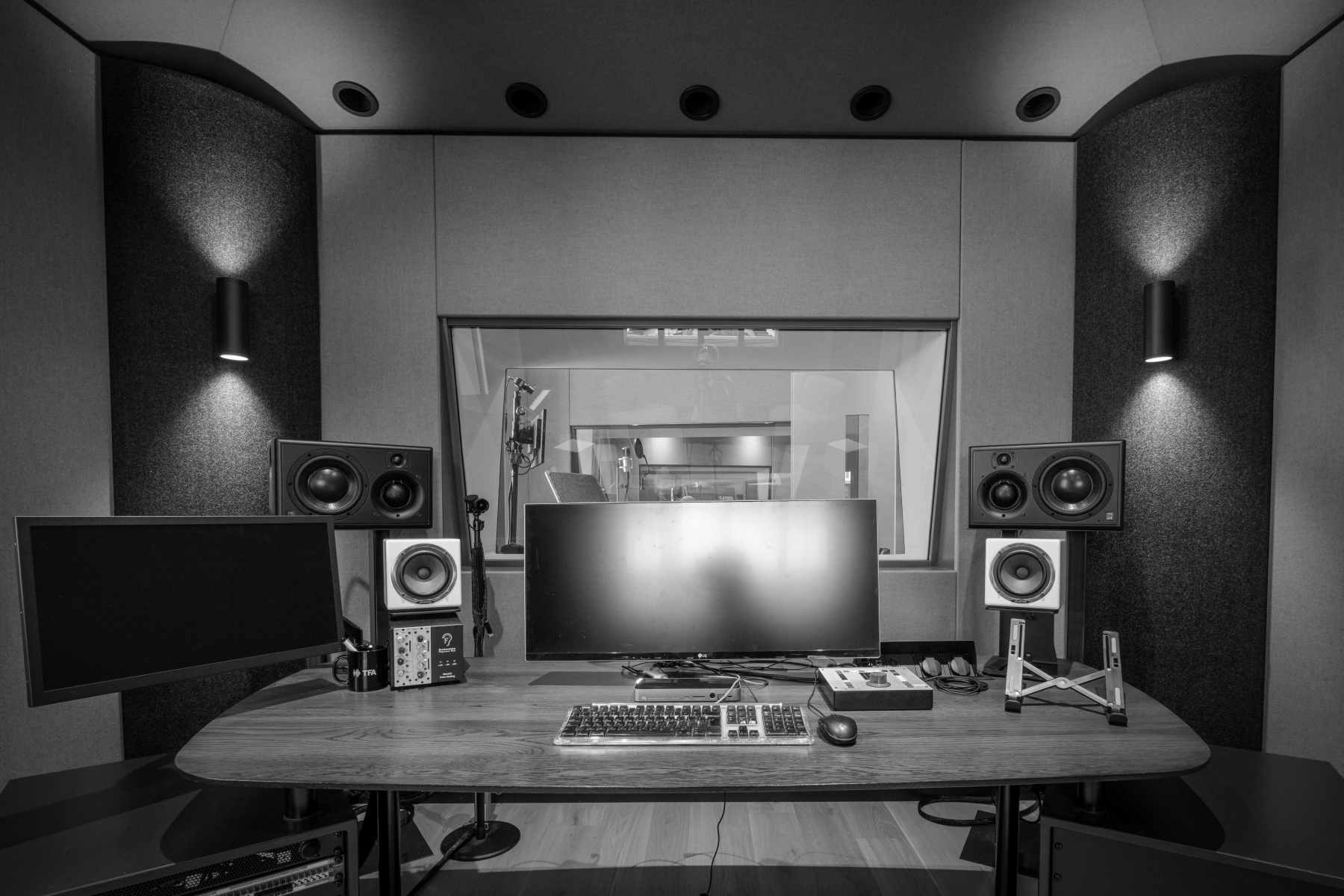
Technically, you’re also working within limits, room dimensions, acoustics, and symmetry. A control room has to be symmetrical, or your stereo image will suffer.
But beyond that, the process is intuitive. It’s like making music. You don’t plan every step; you try something, adjust it, sometimes tear it down, and start again.
That’s why I asked for no deadline on this project. If you have a deadline, you don’t allow yourself to rethink things. And sometimes you need to.
Q: What was the biggest challenge?
Hans: Making everybody happy.
Q: If someone asked you what makes TFA Studios special, what would you say?
Hans: I put all my knowledge into it. It’s built with heart and soul.
Q: Is there a frequency you now personally hold a grudge against?
Hans: The low-mid range, around 100 to 125 Hz.
It’s tricky. Almost every studio has issues there because of the distance between the speakers and the floor. It’s harder to control than the deep low end.
Q: You originally studied something completely different. Can you tell us a bit more about that?
Hans: Yes, psychology.
However, after a few years, I thought, “No, this is not really my thing. It’s not going to work.” In the process of finding a new path, I read in a magazine something about this “School of Audio Engineering” and I instantly knew I was going to do that.
At the time, there weren’t really options for what I wanted to do musically. It was either classical or jazz. I was into rock, so neither appealed to me.
When I started, I became completely absorbed. I spent all my time there, sometimes even slept in the studios.
After I graduated, they asked me to teach. That eventually led to working on studio projects as well.
Q: What inspired you to build your own studio, The Tracking Room?
Hans: I saw too many studios where all the money went into the control room.
Then there was nothing left for the live room, the space where musicians actually play.
But that’s the most important place. If musicians don’t feel comfortable, you won’t get good music.
So I focused on that. For years, it was just one room, and I even mixed in the same space. Only recently did I build a separate control room.
Q: When do you know a project is finished?
Hans: You learn that over time.
You can keep improving forever, but then you never move on. At some point, you have to let go.
For me, that realization came partly with age and partly the hard way.
Q: What do you mean by “the hard way”?
Hans: I had a heart attack in 2022.
That changes things. It forces you to look at how you work, how much stress you carry. I realized I had been pushing too hard, trying to control everything, making sure everything was perfect, keeping everyone happy.
Now I work differently. Slower, more consciously.
Q: Has that changed your lifestyle as well?
Hans: Completely. No alcohol, no sugar, healthier habits.
I’ve also seen people around me, the same age, who didn’t get a second chance. So I consider myself lucky. It was a warning.
Q: Music still remains an important part of your life through your band, The Covenant. What does the band mean to you personally?
Hans: It’s important. I joined the band originally as a recording engineer, but I loved their attitude. They were doing it for the joy of playing.
Later, I joined as a keyboard player, even though I barely knew how to play. Eventually, I moved back to guitar.
It’s a different kind of creativity, less technical, more direct. I need that balance.
Q: If your job had a theme song, which one would it be?
Hans: ‘All You Need Is Love’ by The Beatles
Whether you're looking for a sound logo or the audio production for an entire campaign, we ensure everything is right – from idea to delivery!
.png)
