Clear evidence
Brand meaning, attention and memory
Music changes how listeners interpret a brand and a speaker. It can also support attention and memory, depending on the execution. This is the best-supported part of the research.
Every day, we compose, select and mix music for radio and TV commercials. The research confirms what we hear in the studio: music can shape how people experience, notice and remember your brand. The condition is that the music fits the message and becomes linked to your brand. Here is what the science says.
Music can influence brand associations, attention, memory and brand choice. But a recognizable or popular piece of music is not automatically good for the brand. What decides it is how well the music fits the message and how strongly it is linked to the brand.
Music changes how listeners interpret a brand and a speaker. It can also support attention and memory, depending on the execution. This is the best-supported part of the research.
In experiments, recognizable music increased brand choice by 6 percent. That a consistent campaign melody builds more brand value over time is plausible, but it has not yet been robustly measured.
Music can change how a brand comes across without people rating the product more highly. And a familiar song does not automatically bring your brand to mind. That is why we ask four questions separately.
Recognizing a song is not the same as recognizing a brand. The best music helps people recognize the right brand, understand the message and build the desired associations.
Six lines of research show when music carries a brand. They also show where it goes wrong.
In an experiment with 132 participants, the same radio commercial took on a different meaning with different music. The impression of the brand and the speaker changed; the overall product rating did not. So music helps determine what kind of brand is speaking.
Zander, 2006
Versions with vocals performed better on attention and memory than instrumental versions or a commercial without music. That does not produce a general ranking of hits, covers and original music.
Allan, 2006
Fitting music helped most in radio commercials with a lot of information. At the same time, absorbing music can actually disrupt a complex message. What works depends on the script and on how much attention the music demands.
Lavack, Thakor & Bottausci, 2008
In two experiments with 486 participants, recognizable music increased brand choice by 6 percent. The more people liked the music, the stronger the effect. This was a choice in an experiment, not realized revenue.
Anglada-Tort et al., 2022
Happy and sad music produced different outcomes for recognition and purchase intent. The emotion music evokes is an intermediate result, not automatically the end result for the brand.
Dogaru, Furnham & McClelland, 2024
Fitting music in TV advertising helped people retrieve information later. Music that was both unexpected and irrelevant actually hindered recall. A surprising choice works when the listener can connect it to the message.
Eat to the Beat, 2022 · research on congruence in TV advertising
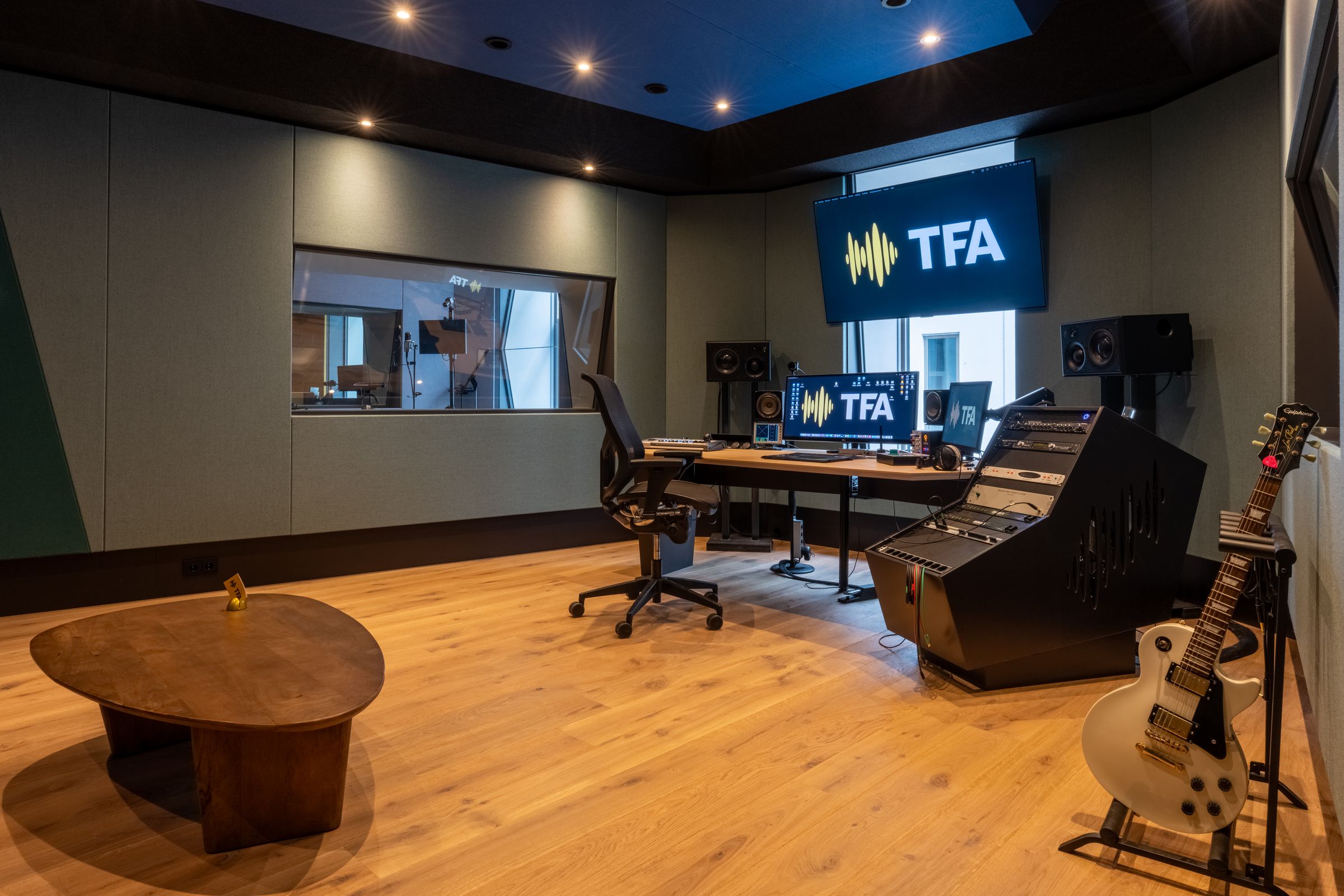

Where music and voice come together: a control room and the recording booth of studio 2.
There are plenty of beliefs about music in commercials. Some hold up, others depend on the execution. Here is how they compare with the research.
This classification is our summary of the sources on this page: an indication, not a meta-analysis.
‘The music fits the brand’ is too vague to steer by. So in a brief we look at six connections. And not at a genre as a fixed formula: classical does not automatically mean premium.
Does the music support the personality your brand wants to convey?
Does the music support what the commercial wants to say?
Does the music fit the visual storytelling or the deliberate contrast?
Do the delivery and meaning of the voice-over stay intact?
Which associations and preferences does the listener bring along?
Does the music build recognition across multiple executions?
This is our working framework, based on the research. It is not the outcome of a single study.
There is no fixed ranking between existing songs and custom music. That is why we assess every choice on six points.
What problem does the familiarity of a hit solve that a new piece of music does not? We ask that question for every existing song.
Fitting music does not have to be predictable. The difference lies in two questions: does the listener expect this music, and does it contribute to the message?
Clarity and recognizable category codes.
A surprise that gives the message meaning.
A familiar style without a clear contribution.
A risk of confusion and distraction. In research, this hindered recall.
An unusual music choice can be justified. The test is whether the listener can connect it to the commercial, not whether the creative team finds it surprising.
The most beautiful track is not automatically the best choice. The difference lies in the brief, selection, composition and mix.
We translate your brand into what the music needs to do: which personality, which message and which role alongside the voice.
That way you know whether music really makes the commercial better. Sometimes the sparser version wins. We want to know that too.
We do not compare one random track, but several options per direction: from the TRX Music Library or composed to order.
Do people recognize your brand by the music, even without the brand name or picture? That is the real test of music as a brand carrier.
Music quieter around the brand name, or only after the main claim? We treat choices like these as hypotheses. We always judge the complete execution.
A radio version is more than the TV spot without picture. For each medium, we decide what the music needs to carry.
The studies answer different questions. So you cannot add them up as if they measured the same effect.
In addition, Allan’s chapter Commercial Sound (2021) organizes experimental research on attention, memory, attitude and purchase intent. It does not provide a universal effect percentage.
This critical literature review is about music as a brand carrier within the commercial, not about radio or television as an advertising medium. We distinguish background music, existing songs, instrumental versions and music made specifically for advertising. The reference date is November 1, 2026.
We used accessible research articles, abstracts, university publication records and review literature. We did not fill in missing sample data or effect sizes with assumptions. Industry benchmarks, such as a secondary discussion of Nielsen research, do not count as evidence that music itself makes the difference. This is not a systematic review or meta-analysis.
This overview belongs with our studies on sonic branding and voices in commercials. You can find all three together on our research page.
More about music for your brand.
Pre-cleared production music or a brand theme of your own by our composers.
An existing song in your campaign? We handle the rights and licenses.
In studio 3, we make custom music for brands, jingles and sonic logos.
The same kind of overview for sonic logos and audio identity.
The same kind of overview for voices in radio and TV commercials.
Sonic branding, voices and music: what the three studies let you hear together.
Not automatically. What counts is fit and the link to your brand.
No, not always. That is why we also listen to a sparser version.
Whether you're looking for a sound logo or the audio production for an entire campaign, we ensure everything is right – from idea to delivery!