News & Releases
10 October 2026

But before that voice can be heard anywhere, someone first has to find the right person. Someone who listens beyond the sound. Who hears what happens between the words.
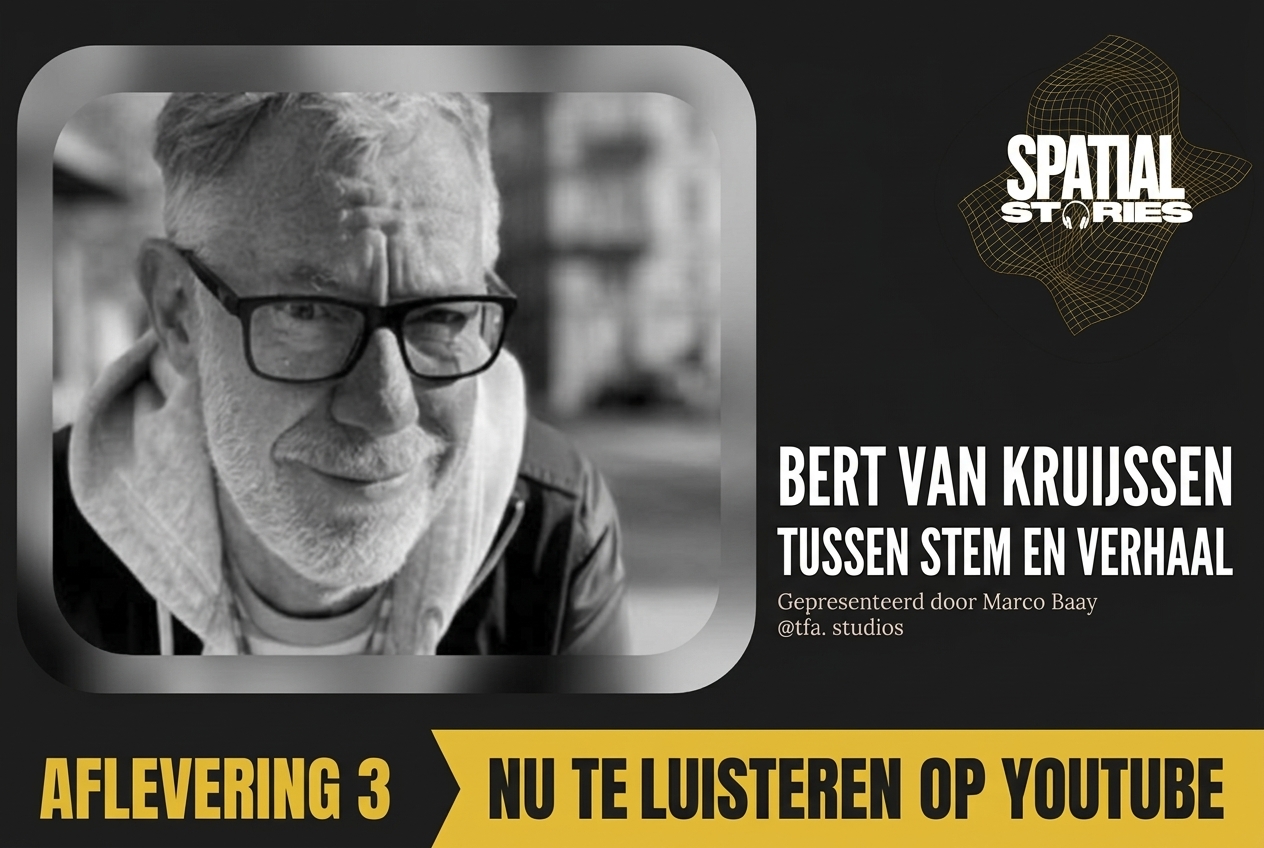
For the third episode of Spatial Stories, our podcast series produced entirely in our Dolby Atmos studio, host Marco Baay boards the train to Zurich. Across from him sits Bert van Kruijssen, who has been a casting director for advertising for decades. As the landscape glides by and the conductor brings cheese sandwiches, they talk about the craft that takes place before a single word is recorded.
Bert doesn't need long to answer the recurring opening question: what do people underestimate about his work? The hardest part is translating what a copywriter has in his head into a voice that actually exists. “Words can never fully capture what you're looking for.”
Bert sees himself as an intermediary. On one side is the client, with a feeling that doesn't have a sound yet. On the other is the voice that will have to deliver on it. With a client he knows well, he knows which direction it's going. With a new client, it's a search. Sending a few test reads. Listening to the reaction. Adjusting. Slowly, the picture comes into focus.
Sounds familiar. In our studio, too, every strong production starts with a good brief, and every vague brief ends in endless searching.
The episode opens with a staged casting session. A voice that is technically perfect is rejected. Why? “Too much of a voice-over. It sounds like someone is trying really hard.” Only with the next voice does it click: “Now I hear a person.”
It is exactly the conviction Bert has championed throughout his career. He stays away from the classic voice-over as much as possible, because to his ears it quickly sounds contrived. He looks for voices that don't read a script but tell a story. Voices that don't sell you something but seduce you.
“It's about very primal feelings,” he says. “Something has to happen inside you when you hear a voice.” Beautiful is not the criterion. A voice has to hit home and at the same time make you think: I'll listen to that, that voice has something to tell me.
Can you learn that? To a certain extent. Technique and script interpretation can be trained. But the voices that move Bert most have it naturally: confidence, a tone of their own, something to say. And you can find that talent anywhere. On stage, but just as easily in a shop or on the street.
A good caster follows the brief, but also dares to question it. A classic example from Bert's practice: the client asks for a male voice. “Why, actually? Shall we listen to a few female voices too?” Or exactly the other way around. The fixed idea that a product simply suits a man or a woman often turns out to be less fixed than expected.
Sometimes that leads to a find that sticks for years. For a radio commercial for an insurance company, an agency was looking for a female voice to play a tour guide on a canal boat. The kind of voice everyone knows and no one remembers. Bert suggested a distinctly masculine performer. The agency and client went along with it, and that gave the commercial exactly the punch it needed.
And then there is the impossible brief. Male or female, we don't know yet. Dynamic but emotional. Down-to-earth and businesslike, but also sensitive. Never heard anywhere before. And above all: with an edge. “Then I throw my hands in the air and we do our best.”
What still gives Bert goosebumps are voices that have become intertwined with a brand over many years. Hadewych Minis for Kruidvat, where you can hear the tone evolve with the times over the years. Anneke Blok for HEMA: “You only need to hear one word and you think HEMA.” Frank Lammers, whom Bert once cast for Arke Reizen and who went on to become a fixture.
It reflects what we experience in the studio every day. A well-chosen voice is not a production choice for a single campaign. It is a brand asset that pays off for as long as you nurture it. You don't build recognition in one campaign. It grows, spot after spot. That's why, in voice-over casting and recording, we devote at least as much attention to the choice as to the recording itself.
The craft itself has changed considerably over the years. When Bert started out, he still had to convince actors to step up to the microphone. An actor once told him: “I can't sell margarine. I'm playing Shakespeare at the Stadsschouwburg tonight.” These days, people come forward on their own. Voice work has become a fully fledged profession.
At the same time, Bert sees room for improvement. In his view, casting is still too often done from a single perspective, while the city we work in has many more accents and backgrounds to offer. It's better than it used to be, but as far as he's concerned, it can't happen fast enough.
And then there's AI. Where clients last year occasionally asked to clone a voice for other languages, Bert now hears that request almost every week. Often with cost savings as the motive. Whether that's the right trade-off is something he openly questions.
We have been working with AI voices for a few years now and see both their strengths and their limits. For some applications, it's a smart choice. But AI is the tool, the ear remains ours. Technology is a prerequisite, not a goal. What makes a voice convincing is what Bert describes throughout the entire ride: a human being with something to say.
A good casting director doesn't just look for a voice. He looks for the feeling behind it. That's not a trick and not a database. It's listening with experience, daring to deviate from what's asked, and knowing when something is right.
Because in the end, nobody remembers a script. We remember how someone said something to us.
What voice do you hear when you think of your brand?
Ideally, listen to the full episode with headphones. Then you'll be sitting in the compartment with Marco and Bert.
Haven't heard them yet? Also check out episode 1 with Hugo Metsers on the voice that sticks, and episode 2 with Aron van der Ploeg on what happens before a song is heard in a campaign.
Whether you're looking for a sound logo or the audio production for an entire campaign, we ensure everything is right – from idea to delivery!
